Study Finds Hunger Alters Food Imagery, Suggesting Cravings Are Not Just a Matter of Willpower
10/19/2026 / By Coco Somers

A new study involving about 60 participants has found that hunger changes how the brain processes food-related thoughts, according to researchers. The findings suggest that cravings may stem from biological signals rather than a simple lack of discipline.
The study, which has not yet been peer-reviewed, adds to a growing body of research indicating that willpower alone is not sufficient to explain why people struggle to resist food. “Cravings are not a willpower problem,” according to one online summary of the research. “They are a signal — from your body and from your brain. Knowing the difference changes everything” [1].
The research comes amid broader scientific interest in the neural mechanisms underlying appetite and reward. Previous studies have shown that hunger can trigger cravings for food just as loneliness triggers cravings for social interaction, with both activating similar brain regions [2].
How Hunger Changes Food Thoughts
Researchers asked participants to imagine the flavor, smell, and texture of various foods, then measured how vivid, easy, and fast those images came to mind. The exercises were conducted while participants were hungry and again after they had eaten.
According to the study, when participants were hungry, food-related thoughts felt stronger. “They were easier to generate, more vivid, and came to mind more quickly,” the report stated. The effect was particularly noticeable for flavor-related imagery.
The results indicate that hunger does not merely increase appetite but also enhances the brain’s ability to simulate sensory experiences of food.
Hunger Does Not Just Increase Appetite
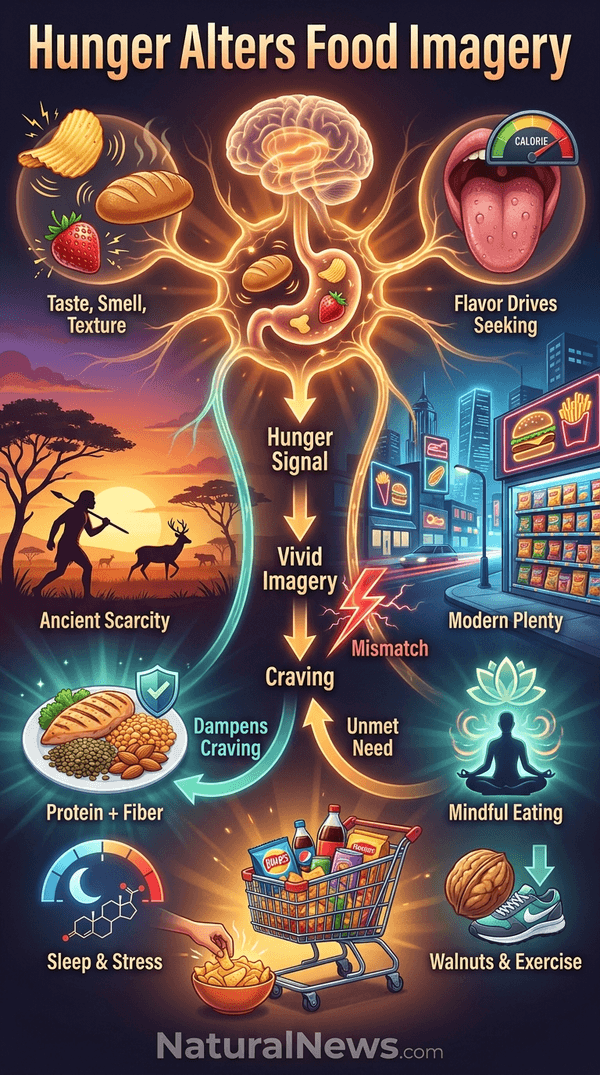
The brain responds to hunger as a biological signal indicating a need for energy, which can make food thoughts more attention-grabbing and harder to ignore. From an evolutionary perspective, heightened focus on food during hunger would have helped humans survive periods of scarcity.
“The same biological system that once helped humans survive now operates in a world where highly rewarding foods are available on every corner,” the report stated. In modern environments of food abundance, a craving may reflect a designed response rather than a failure of willpower.
Some critics of processed foods have argued that such products are formulated to be especially rewarding, though the study focused on hunger’s effect on food imagery. Other research has found that walnuts can “trick” the brain into feeling full by activating an area that regulates hunger and cravings [3]. Similarly, studies on exercise have shown that moderate-to-vigorous activity may reduce food cravings [4].
Navigating Cravings Before Hunger Escalates
The study highlights that cravings are easier to manage when people do not let themselves become overly hungry. Recommended habits include prioritizing protein at meals to stay fuller longer, including fiber-rich foods, avoiding long stretches without eating, and keeping nutritious snacks on hand.
One weight-loss guide advises including protein with all main meals: “Eating fruits for example with a handful of almonds will keep you satiated for a lot more time than if you had eaten them plain” [5]. The same source emphasizes attentive eating and mindfulness meditation as tools for managing cravings.
The report also advised against grocery shopping on an empty stomach, noting that hunger can alter food decisions. Additionally, hunger can be influenced by sleep, stress, and environment [6].
Takeaway
The findings suggest that hunger changes how vividly and convincingly the brain can imagine food, making it more rewarding and difficult to ignore. Successful eating habits rarely depend on willpower alone; they rely on routines that make good decisions easier before hunger intensifies.
Sometimes the smartest nutrition strategy is not resisting a craving but preventing the hunger that makes the craving impossible to ignore.
The research aligns with a broader scientific consensus that appetite regulation involves complex biological systems.
References
- Cravings are not a willpower problem. https://www.facebook.com/angelo.d.paz/posts/cravings-are-not-a-willpower-problem-they-are-a-signal-from-your-body-and-from-y/10165183548616257/
- Cravings for social contact mimic hunger in the brain study reveals – NaturalNews.com, November 30, 2020.
- Walnuts reduce hunger and cravings by changing your brain – NaturalNews.com, May 17, 2018.
- How Exercise Influences Hunger and Weight Los – Mercola.com, October 05, 2012.
- Easy Weight Loss 30 Easy tips to Lose Weight without Food Restriction Counting Calories or Exercise by Fotis Chatzinicolaou
- Your cravings aren’t always about “willpower.” And constantly …. https://www.instagram.com/reel/DeNDMTdRoKV/
Explainer Infographic
Submit a correction >>
Tagged Under:
appetite, brain activity, brain function, brain signaling, cravings, discoveries, food choices, food imagery, food science, hunger, mental health, mind, mind body science, psychology, real investigations, research
This article may contain statements that reflect the opinion of the author
RECENT NEWS & ARTICLES